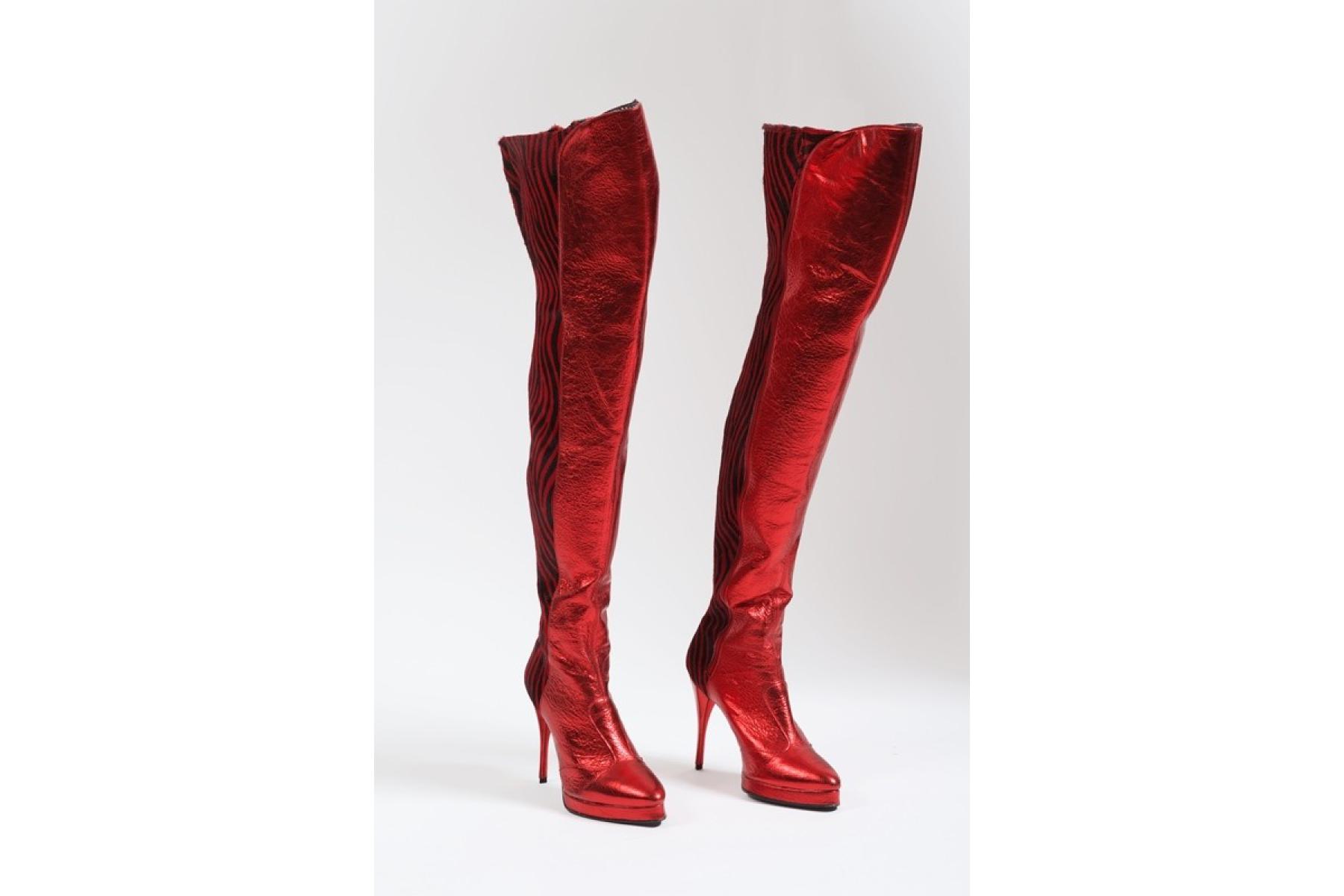
Over the knee, high heeled boots made as props for the 2005 film Kinky Boots
There is a long history of shoemaking in Northamptonshire coupled with a sense of entrepreneurialism and single mindedness to create success out of adversity.
These extraordinary boots were made for the 2005 film Kinky Boots. The film is based on the true-life story of Steve Pateman whose family firm W. J. Brooks in Earls Barton had made shoes for four generations from 1889.
In the late 1990s the business had hit hard times like many other county firms. Rather than give up, he made a now famous decision to diversify. The opportunity arose when Pateman was asked by the owner of a Folkstone shop selling footwear worn by cross-dressers and drag queens if he could make thigh-high boots, in red or black leather or PVC, in male sizes. His risk paid off and caught the attention of the BBC who featured the factory in the BBC Two documentary Trouble at The Top in 1999. The story went on to inspire the Golden Globe award-winning movie and the multi-Tony Award winning Broadway musical.
This boot is a film prop and quite different from those made by Pateman who invested £12,000 in a machine that could attach four and a half inch (11.4 cm) heels. He researched his potential customer base and began creating his own designs. His boots were reinforced with a metal strut to take the weight of a man. The range was marketed under the name Divine Footwear and Pateman himself modelled the footwear in the catalogue.
Number 97 of the objects selected for the A History of Northamptonshire in 100 Objects exhibition 2025.
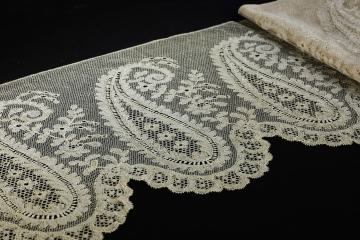
This Paisley Pear is an exceptional piece of Bucking Point Bobbin lace. Lacemaking was a prominent Northamptonshire industry from the 17th to 20th centuries.

 © NMAG
 ©
NMAG
©
NMAG
 ©
NMAG
©
NMAG
 ©
NMAG
©
NMAG
 ©
NMAG
©
NMAG