Skip to main content Accessibility statement

We use cookies on this site to enhance your user experience.

By clicking the Accept button, you agree to us doing so. More info on our cookie policy.

View in timeline

Roman Pots from Irchester

late 2nd centuary Roman and Early Medieval

These Roman pots, of varying styles, were excvated in 2023 and 2024 at the site of the Roman town of Irchester, near to Wellingborough.

Roman pottery vessels © ARC
Roman pots excavated from Irchester Roman Town 2024

These pots were discovered as part of the Irchester Archaeological excavations as part of the annual Field School - a community and reserach excavation run by the Northamptonshire Archaeological Resource Centre and the University of Leicester at the site of the Roman town at Chester House Estate.

A series of over 20 complete and mostly complete pots dating to the late 2nd century CE were discovered from a single pit. They represent a large selection of types of pots that would have been used everyday including bowls, flagons, storage vessels and cooking pots. 

They are now on display in the galleries at Chester House Estate. 

Irchester Roman Town
Contributed by Northamptonshire Archaeological Resource Centre

Explore related content (external site)

See our disclaimer

Related objects

  • Solid Roman bronze horse and rider statuette, possibly a votive offering. © NMAG
    Roman and Early Medieval

    Roman Horse and Rider Statuette

    A bronze statuette of a horse and rider. This object is probably a votive or religious object left at the site of a Roman shrine.

  • Roman coin hoard buried in Wootton Fields, Northampton. © NMAG
    Roman and Early Medieval

    Wootton Coin Hoard

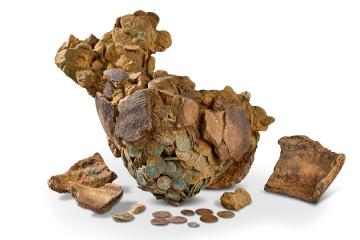
    Containing over 1900 coins this Roman hoard was found in Wootton Fields. They were buried during the later Roman period in a black pot.

  • Roman mosaic fragment
    Roman and Early Medieval

    Roman Mosaic Floor Fragment

    This fragment of Roman mosaic flooring is on display in Daventry Museum. It is part of a larger decorative floor, discovered in 1823 on Borough Hill, Daventry by historian George Baker, with a full excavation carried out in 1852 by Beriah Botfield, MP.

  • Bronze, enamelled Roman vanity set hung from a chatelaine © NMAG
    Roman and Early Medieval

    Roman Chatelaine

    This astonishingly well preserved example of a chatelaine (collection of personal grooming objects), is a high-status object made to be seen as much as used.