Medieval lead cannonball fired during the Battle of Northampton in 1460
The first battle fought in England using artillery happened on 10 July 1460 near Delapré Abbey, Northampton, during the Wars of the Roses. The War of the Roses was a series of civil wars fought between the House of Lancaster and the House of York for the English throne between 1455 and 1487.
At the battle the Lancastrian army built a fortification and filled it with guns, hoping the Yorkists would attack. Unfortunately, their guns mostly misfired, so we know this cannonball was fired by the Yorkist army commanded by the Earl of Warwick, known as the Kingmaker. Although the Lancastrians were defeated and King Henry VI captured, the Yorkists still recognised him as king and swore him loyalty.
This cannonball was found after the River Nene was dredged in the 1970s. It had rolled to the edge of the mud and weeds and was sitting just next to the footpath. You can see from its shape it isn’t natural. Its original spherical shape was elongated because of the huge forces created by the cannon firing. These also caused the marks on it from the wadding used in loading the cannon. It’s heavy for its size, weighing slightly over a kilogramme (1,121g).
This is an artefact of national importance, proof of the earliest use of cannons on a battlefield in England.
Number 45 of the objects selected for the A History of Northamptonshire in 100 Objects exhibition 2025.
Delapré Abbey, Northampton
Contributed by Steve Pulley, Northamptonshire Battlefields Society
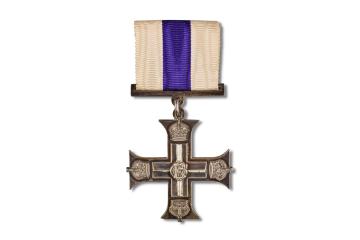
First World War Military Cross awarded to Lieutenant OK Parker for gallentry during what is often called the blackest day in the Northamptonshire Regiment's history.
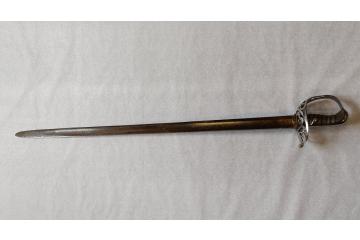
A cavalry officer’s heavy sword carried in the Battle of Waterloo, 1815. It is 102cm long, with a matching scabbard. It is made from metal with decoration on the blade called blue and gilt, which has now faded.

 © NMAG
 ©
NMAG
©
NMAG
 ©
NMAG
©
NMAG
 ©
Delapre Abbey
©
Delapre Abbey
 ©
NMAG
©
NMAG