Skip to main content Accessibility statement

We use cookies on this site to enhance your user experience.

By clicking the Accept button, you agree to us doing so. More info on our cookie policy.

View in timeline

Iron Age Reaping Hook

Iron Age 300-150 BCE Geologic to Prehistoric

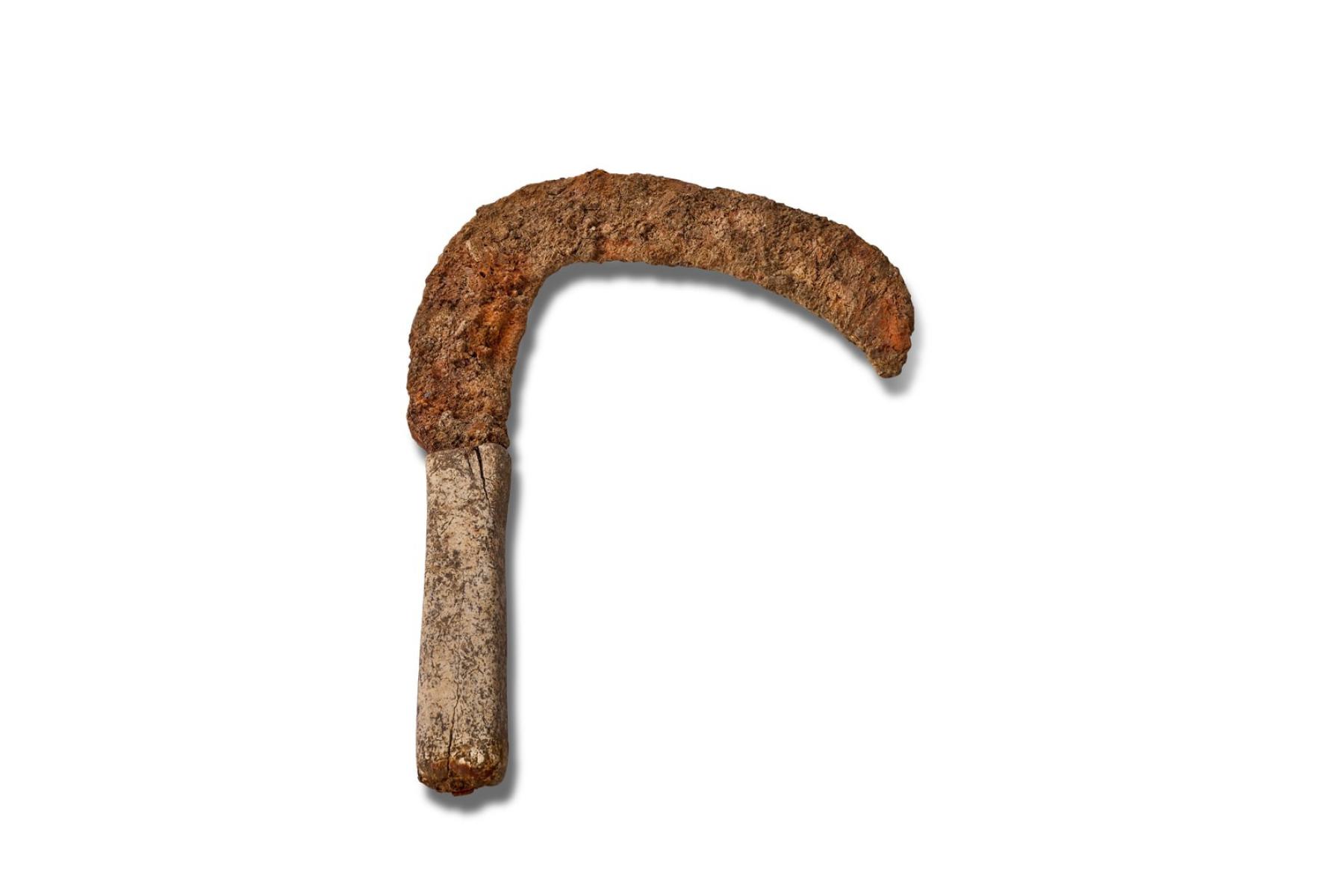
A well preserved reaping hook, on one hand an everyday farming implement, on the other a symbol of prehistoric farming.

Iron Age reaping hook - iron blade with bone handle © NMAG
Iron Age reaping hook - iron blade with bone handle

This well-preserved Middle Iron Age reaping hook found in Brackley, looks like an everyday farming implement, but it is a symbol of prehistoric farming. Most modern people would recognise it; such utilitarian tools change very little over thousands of years but despite its mundane first impression, this agricultural tool helps us visualise the lives of the Iron Age community.

The reaping hook comprises a curved, tanged iron blade hafted onto a bone handle. The handle shows signs of excessive wear showing that it was well-used before burial. It was so well-preserved because it was deliberately placed in clay, possibly as a ritual offering during the construction of a granary, perhaps to ensure plentiful future harvests. It is likely that this object held far greater significance to its original owners than its first impression suggests.

Brackley
Contributed by Charlotte Walker, Historic Environment Record

Explore related content (external site)

See our disclaimer

Related objects

  • CPAP medical equipment to assist with paitient's breathing.  © NMAG
    Modern

    CPAP Device

    Designed by engineers at Mercedes HPP the CPAP device was developed in response to the need for a device to assist COVID patients to breathe.

  • Flint dagger from Bronze Age barrow at Stanwick Lakes. © NMAG
    Geologic to Prehistoric

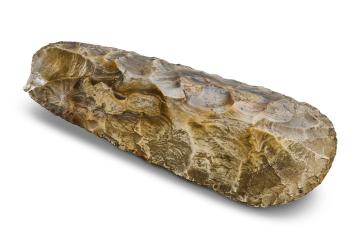
    Bronze Age Flint Dagger

    This flint dagger was found in a male burial in a barrow along with other grave goods. It had never been used so may have been an ornamental or ritual piece.

  • Leg bone of a woolly rhinocerous from Wollaston, Northamptonshire. © NMAG
    Geologic to Prehistoric

    Woolly Rhinoceros Bone

    This ulna (leg bone) comes from a woolly rhinocerus that lived in Northamptonshire during the Pliocene and Pleistocene ice Age.

  • Obverse (head) of Viking silver coin found in Northampton. © NMAG
    Roman and Early Medieval

    Viking Silver Coin

    There is limited evidence of Viking influence in Northamptonshire and despite being minted during Viking rule this silver coin from Northampton depicts an Anglo-Saxon king.