
Search
-
 ©
UNAS
©
UNAS
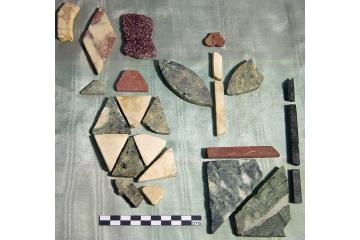
Mediterranean marble used as decorative inlays on luxurious Roman furniture
These marble pieces were excavated at the Roman villa at Piddington, from a third or fourth century rubbish heap.
3rd century Roman and Early Medieval
-
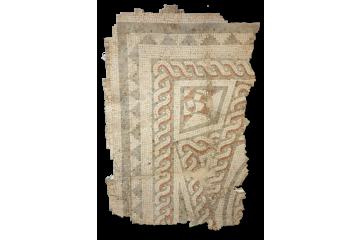
Roman Mosaic Floor Fragment
This fragment of Roman mosaic flooring is on display in Daventry Museum. It is part of a larger decorative floor, discovered in 1823 on Borough Hill, Daventry by historian George Baker, with a full excavation carried out in 1852 by Beriah Botfield, MP.
Early Roman Roman and Early Medieval
-
 ©
NMAG
©
NMAG
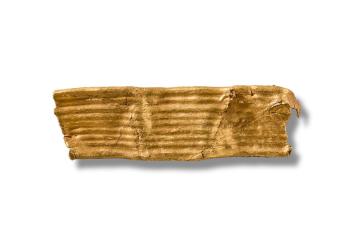
Early Bronze Age Ribbon
A short piece of decorated gold strip or ribbon dating to the Bronze Age.
Early Bronze Age Geologic to Prehistoric
-
 ©
NMAG
©
NMAG
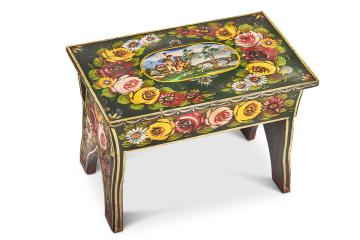
Frank Nurser Canal Stool
Painted stool in Castles and Roses folkart style, used to decorate everyday items used by bargees, people who lived and worked on Northamptonshire's canal network.
Georgian 1815 Stuart to Georgian
-
 ©
NMAG
©
NMAG
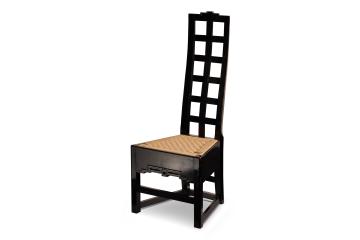
Mackintosh Chair
This chair is one of four made for Wenman Bassett-Lowke and his house at 78 Derngate, whose decoration was designed by Charles Rennie Mackintosh.
1917 Modern
-
 ©
Delapre Abbey
©
Delapre Abbey
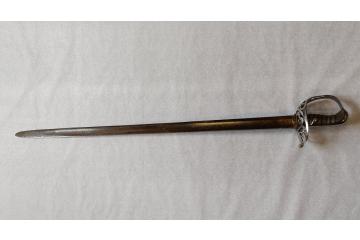
Everard Bouverie's Waterloo Sword
A cavalry officer’s heavy sword carried in the Battle of Waterloo, 1815. It is 102cm long, with a matching scabbard. It is made from metal with decoration on the blade called blue and gilt, which has now faded.
1812 Stuart to Georgian
-
 ©
NMAG
©
NMAG
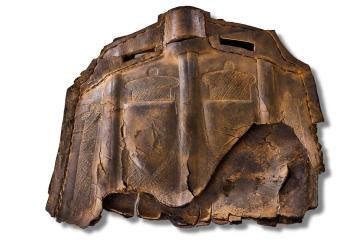
Costrel
Medieval leather flask (costrel) used for water or other drinks. Found in the Market Square, this example is embossed with a sword motif.
Medieval 1425 - 1475 Medieval to Tudor
-
 ©
NMAG
©
NMAG
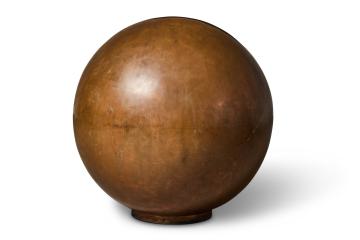
Fountain Ball
This copper ball was added in the 1950s to the Victorian ornate cast iron fountain installed in the Market Square, Northampton.
Victorian 1863 Modern
-
 ©
NMAG
©
NMAG
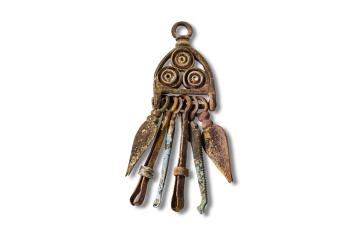
Roman Chatelaine
This astonishingly well preserved example of a chatelaine (collection of personal grooming objects), is a high-status object made to be seen as much as used.
Roman - first century CE Roman and Early Medieval
-
 ©
NMAG
©
NMAG
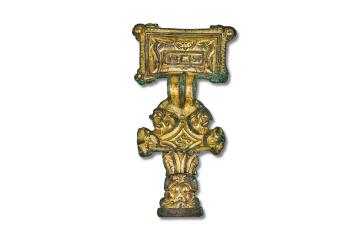
Wakerley brooch
Excavated from a burial in an Anglo-Saxon cemetery, this square headed brooch is unusual in being marked with a runic inscription on the back.
Saxon 500 - 700 CE Roman and Early Medieval