Elaborately carved stone grave slab - St Peters, Marefair, Northampton
1150
Medieval to Tudor
This 12th century grave slab is located in the church of St Peter, Marefair in Northampton. It is thought to have been carved by the same sculptors as the beautifully preserved set of Norman capitals (headings of columns) in the church.
Carved grave slab St Peters, Marefair, Northampton
Art historians interpret this Stone as a grave cover, designed to be viewed from above. There is no name or Christian symbolism on the stone slab but it was probably made for someone of some importance.
The decoration is elaborate and influenced by illustrated manuscripts of the same period. On the stone the motif of Renewed Life is surrounded by interlaced foliage, beasts and cosmic circle - themes familiar in 12th century philosophy. The bearded head in the centre is breathing out loops of vine with leaves and flowers, a stream of Creation. Disgorging heads like this were described by the Victorians as "Green Men". The loops enclose two dragons, one winged and one without – both are biting their own tails.
The stone was discoveredin 1843 by a local antiquarian - it had been reused as the lintel in a cottage on Black Lion Hill, close to the church. It was displayed at the Hayward Gallery in London in 1984 as part of the Englih Romaneque Art 1066 to 1200 exhibition and St Peters has been described as the "finest 12th century church in the county".
Some recent writers have described the stone as Saxon. This error is understandable because thehead in the centre has a Scandinavian look about it. Northampton had been part of the Danelaw area and the Anglo Scandinavian cultural influence survived
Northampton
Contributed by Friends of St Peters, Marefair, Northampton
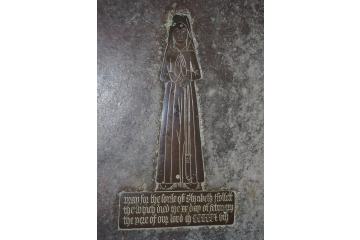
This tomb is believed to be that of a young girl, Elizabeth Follett, thought to be the daughter of John Follett a stonemason in the employ of Lady Margaret Beaufort at her Palace in Collyweston. Elizabeth Follett was buried in February 1508.

 © Friends of St. Peter's Marefair Northampton by Rafal
 ©
NMAG
©
NMAG
 ©
NMAG
©
NMAG
 ©
NMAG
©
NMAG