Skip to main content Accessibility statement

We use cookies on this site to enhance your user experience.

By clicking the Accept button, you agree to us doing so. More info on our cookie policy.

View in timeline

Welford Cup

Tudor 1518/9 Medieval to Tudor

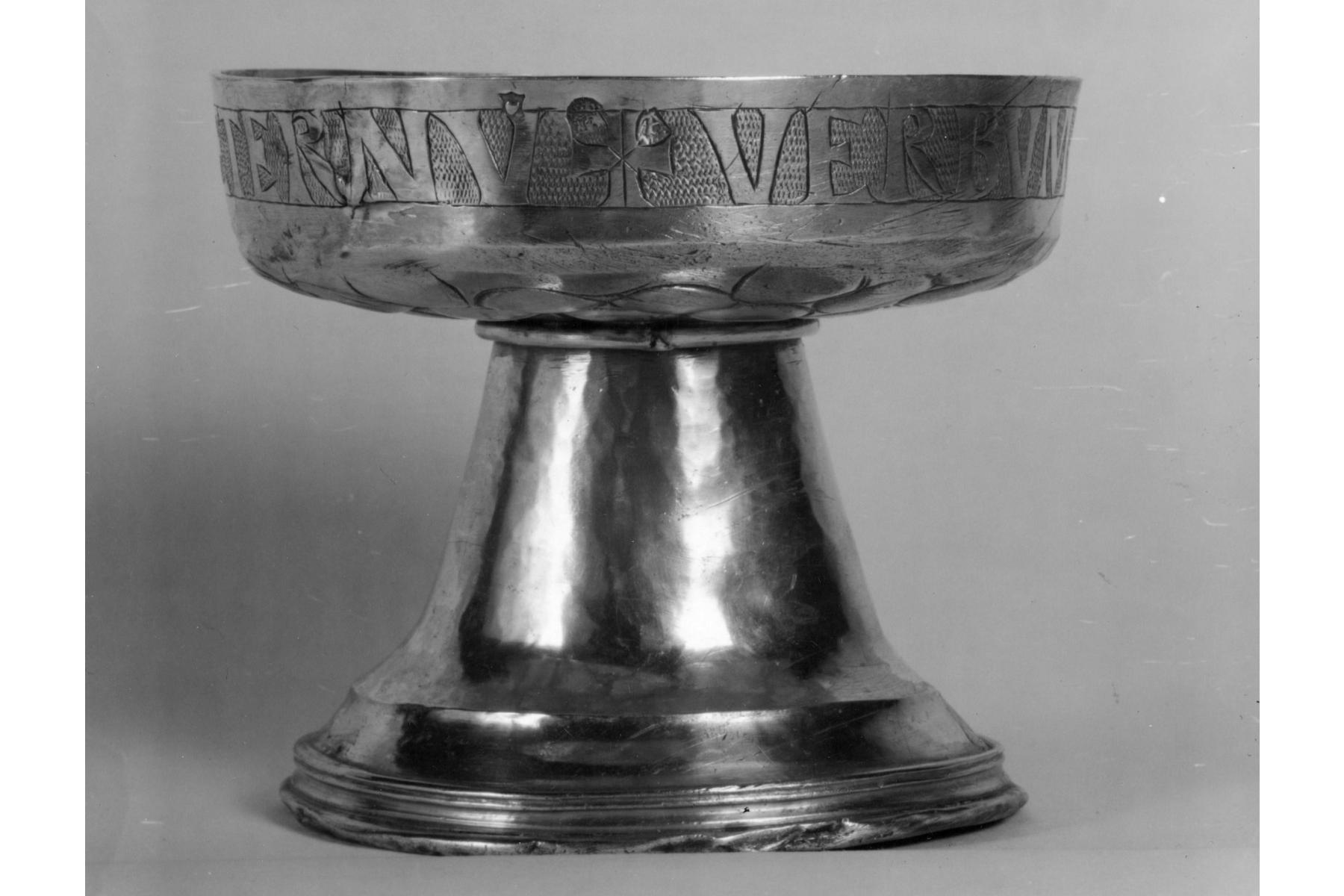
A silver cup, known as a Tudor grace cup, used as a domestic but ceremonial drinking cup passed around the table after prayers.

Tudor silver cup made in 1518/19. © The Trustees of the British Museum
Tudor silver cup made in 1518/19.

Discovered in 1968 buried in a field between Welford and Sulby this silver cup has been identified as a a Tudor grace cup - a domestic, ceremonial drinking cup passed around the table after prayers were said. It is London hallmarked silver and dated 1518 to 1519, likely made by Robert Amadas, goldsmith to King Henry VIII.

The cup has been restored by the British Museum so that you can see the Latin inscription, which reads ‘The word, O Lord, lasts forever’.

It is unclear how it came to be buried in farmland in Northamptonshire. It may be related to the presence nearby of Sulby Abbey, a Premonstratensian monastery, a religious order of canons regular in the Catholic Church. It was perhaps hidden by the friars during the dissolution of the monasteries when Henry VIII seized the abbey, its land and valuables in 1538. Alternatively it could be evidence of the looting during times of unrest. The Battle of Naseby, turning point in the English Civil War was fought just two miles from Welford and in the run up to the battle in June 1645 many Northamptonshire villages were plundered by soldiers from both sides.

Number 49 of the objects selected for the A History of Northamptonshire in 100 Objects exhibition 2025.

Main image: © The Trustees of the British Museum. Shared under a Creative Commons Attribution-NonCommercial-ShareAlike 4.0 International (CC BY-NC-SA 4.0) licence.

Welford and Sulby
Contributed by Welford and Sulby Historical Society

Explore related content (external site)

See our disclaimer

Related objects

  • Appliqued and embroidered table cloth made by members of the Weston Favell branch of the Women's Institute © NMAG
    Modern

    Tablecloth

    Made by members of the Weston Favell branch of the Women's Institute to celebrate Queen Elizabeth II's coronation, this tablecloth is still in weekly use.

  • Treaty of Edinburgh signed at Northampton Castle in 1328. © National Records of Scotland
    Medieval to Tudor

    Treaty of Edinburgh - Northampton

    In 1328, England's parliament met at Northampton Castle; where they agreed this peace treaty officially marking the end of the First War of Scottish Independence.

  • Discarded (partially worked)  antler chess pieces © NMAG
    Medieval to Tudor

    Bishop and Queen Chess Pieces

    These two discarded 12th century antler chess pieces were made in a workshop and are evidence of Northampton as a bustling medieval centre.

  • Aluminium sterilising drum with syringe and cotton swab © NMAG
    Modern

    Dr Waddy's Sterilising Drum

    Sterilising drum belonging to Dr Francis Fisher Waddy, first anaesthetist at Northampton General Hospital. The drum contained small items of anaaesthetic equipment during their sterilisation.