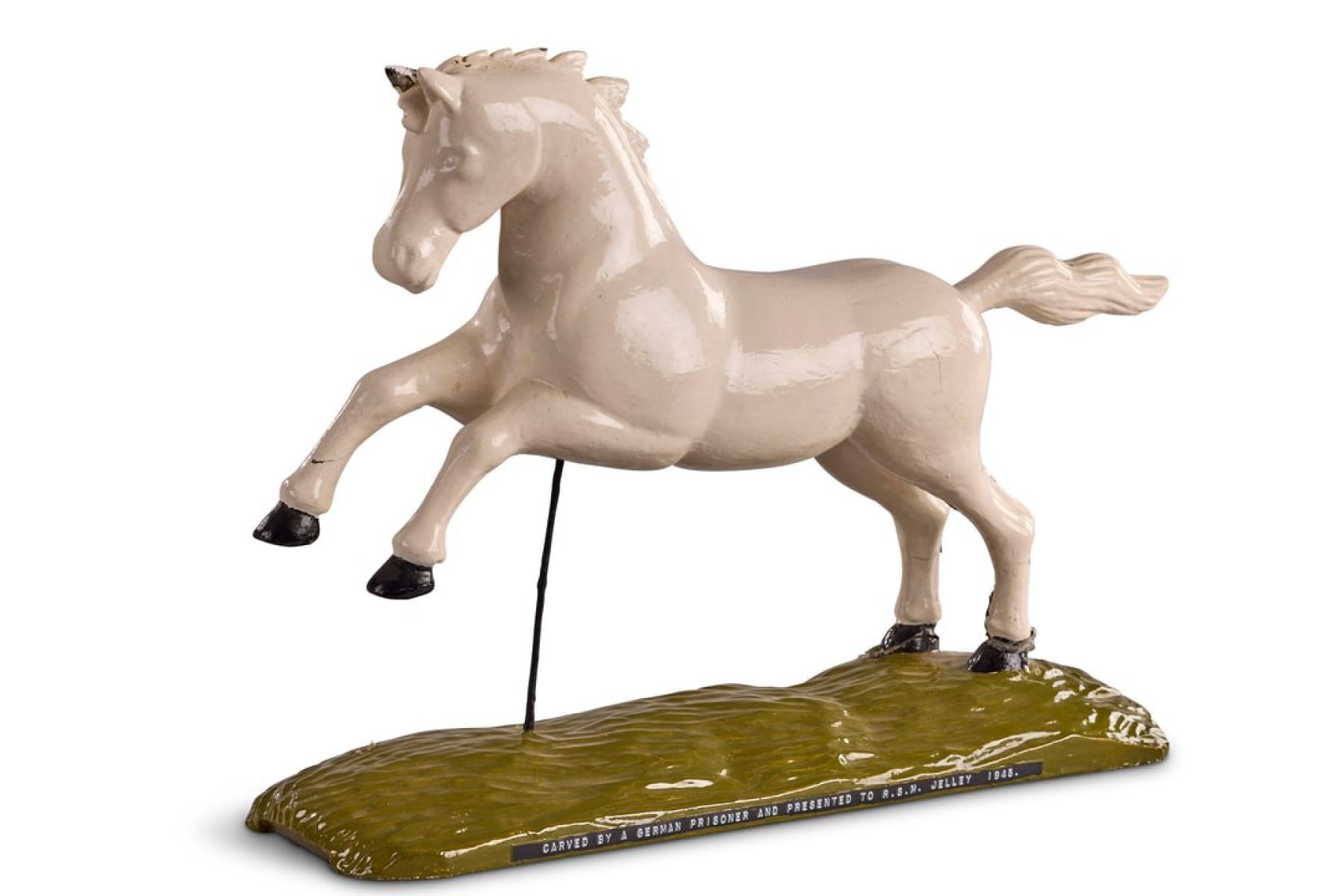
Wooden model of the Northamptonshire Yeomanry badge depicting a white horse.
The Northamptonshire Yeomanry was formed in 1794, as a volunteer cavalry regiment. Some of its members served in the Second Boer War of 1899. They were mobilised in 1914, as part of the Territorial Army, seeing service in Belgium, France and Italy.
In 1921 it became part of the Royal Armoured Corps. In 1939 a second line Regiment was formed. Both Regiments landed in Normandy in 1944. They fought through the many armoured battles, to breakout from the Normandy bridgehead. The second Regiment, due to losses in tanks and crew men, were disbanded after only eight weeks in action. The first regiment fought on through Belgium and Holland and took part in the crossing of the River Rhine into Germany in 1945.
The Regiment would serve in different armoured territorial units until they were finally stood down in the early 1970s.
The White Horse of Hanover was given to the Regiment by the German King George III in 1794 as the Regimental Badge.
While the Regiment was part of the occupation forces in Germany, German prisoners of war were employed as labourers, interpreters and other roles. One of these prisoners carved this wooden horse for Regimental Sergeant Major (RSM) George Jelley, who had served as a boy soldier in the Royal Artillery during the First World War.
Number 61 of the objects selected for the A History of Northamptonshire in 100 Objects exhibition 2025.
Northampton
Contributed by David Parish, NMAG Military volunteers
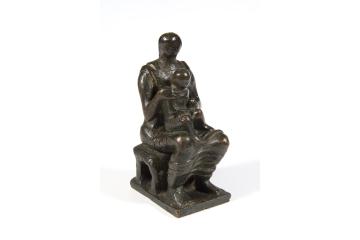
Maquette (preliminary model) for Madonna and Child statue at St Matthews Church, Northampton. It was commissioned from the now-famous sculptor Henry Moore.
 © NMAG
 ©
NMAG
©
NMAG
 ©
NMAG
©
NMAG
 ©
NMAG
©
NMAG
 ©
NMAG
©
NMAG